Cart
0
Quick Answer
Table salt is mined from underground, finely ground, and usually has iodine added. Sea salt is made by drying seawater, has bigger grains, and usually has no added iodine. Both have about the same sodium and nutrition. The real differences are texture, taste, and iodine.
Introduction
Sea salt and table salt are both mostly sodium chloride, but they differ in grain size, taste, and iodine content. Neither one is healthier than the other.
This guide explains how they differ and which one to use in your kitchen.
What Is Table Salt?
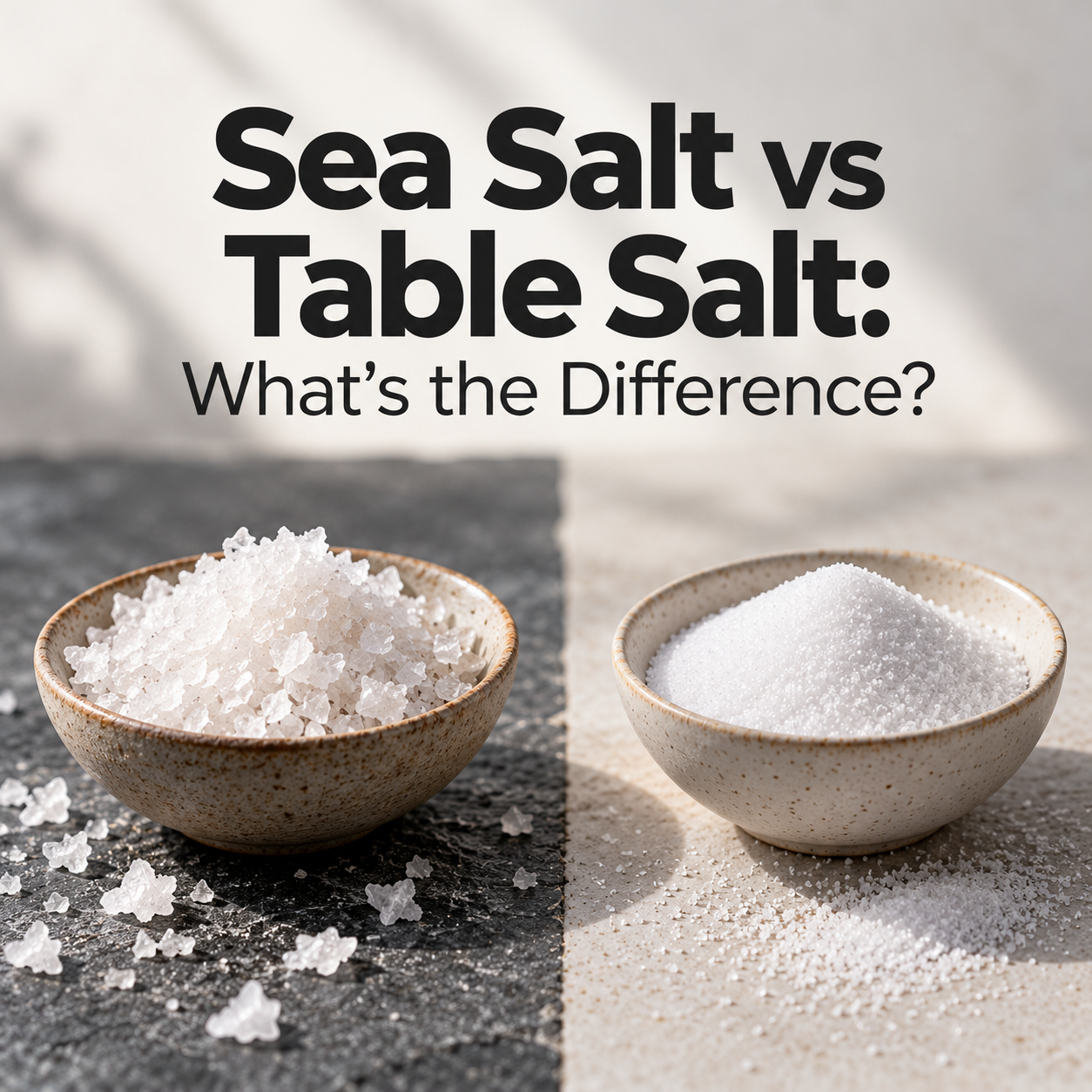
Table salt is fine white salt that comes from underground salt deposits. Workers refine it to remove other minerals, giving it a fine texture.
Most table salt has iodine added, which is why it is called iodized salt. It also contains a small amount of anti-caking agent to keep the grains from clumping in the shaker.
Overall, table salt is fine, refined, and usually iodized.
What Is Sea Salt?
Sea salt is made by drying seawater and is less refined than table salt. As a result, it keeps tiny amounts of minerals.
These minerals can slightly change the color and taste. Sea salt also comes in different forms, including fine grains, coarse grains, and flakes.
Overall, sea salt is dried seawater with a slightly more natural texture.
How Do Sea Salt and Table Salt Compare?
Here is a quick side-by-side look at their main differences.
|
Table Salt |
Sea Salt |
|
|
Source |
Underground deposits |
Dried seawater |
|
Processing |
More refined |
Less refined |
|
Grain size |
Fine |
Fine, coarse, or flaky |
|
Iodine |
Usually added |
Usually not added |
|
Sodium by weight |
About 40% |
About 40% |
|
Taste |
Plain and salty |
Plain, with a mild mineral note |
|
Best for |
Baking and daily cooking |
Finishing and daily cooking |
|
Cost |
Low |
Higher |
Sea salt usually costs more than table salt. Fancy sea salt can cost about 25 times more per ounce.
Is Sea Salt Healthier Than Table Salt?
No. Sea salt and table salt have the same basic nutrition, although sea salt keeps a few extra minerals. However, the amounts are very small.
Even salts known for their minerals contain very little. For example, a quarter teaspoon of pink salt has about 2 mg of calcium, while adults need around 1,000 mg a day.
This means you cannot rely on salt to get enough minerals. Get them from real food instead.
Neither type of salt is a health food.
Does Sea Salt Have Less Sodium?
No. Both salts are about 40 percent sodium by weight. Sodium is the part of salt that can raise blood pressure when you eat too much.
However, big crystals leave gaps in a measuring spoon, so a teaspoon of coarse sea salt holds less salt than a teaspoon of fine table salt. This is a measuring difference, not a real reduction in sodium. If you weigh the two types, their sodium content is the same.
Health experts recommend that adults eat no more than 5 grams of salt a day. That is 2 grams of sodium, or about 1 teaspoon. Worldwide, the average salt intake is about 10.8 grams a day.
In the end, how much salt you eat matters more than which type you choose.
Does Sea Salt Have Iodine?
Usually not. Most sea salt has no added iodine, and the label often says so.
Iodine is a mineral your thyroid needs to make hormones, and adults need about 150 micrograms a day.
If you switch to sea salt, you can still get enough iodine from other sources. Try these simple options:
-
Buy iodized sea salt.
-
Eat eggs, fish, shrimp, or seaweed.
-
Keep a small jar of iodized table salt for daily use.
If you are pregnant or have a thyroid problem, ask your doctor before you stop using iodized salt.
Sea salt is fine if you get iodine from somewhere else.
Which Tastes Better, Sea Salt or Table Salt?
The difference is small. In taste tests, fancy salts mostly tasted like plain salt, although some had a mild mineral hint.
Texture makes a bigger difference. Large sea salt flakes add a nice crunch to the top of food.
Many people say sea salt tastes better, and your mind may play a part in that preference. That is fine. Pick the one you enjoy.
Sea salt stands out more for its crunch than for its saltiness.
Can You Use Sea Salt Instead of Table Salt?
Yes, but measure by weight when you can because grain size changes how much salt fits in a spoon.
Here is a simple guide:
-
One tablespoon of table salt weighs about 19 grams.
-
One tablespoon of fine sea salt weighs about 15 grams.
-
Flaky sea salt can take about 3 tablespoons to match 1 tablespoon of table salt.
-
For baking, use table salt or fine sea salt because they dissolve quickly.
-
For finishing a dish, use flaky sea salt.
A kitchen scale makes this easy and helps keep your recipes consistent every time.
When swapping salts, measure by weight rather than by spoon.
What About Pink, Kosher, and Celtic Salt?
Here is a quick look at three other popular salts:
-
Pink salt: It is mined and has a pale pink color. It usually has no added iodine.
-
Kosher salt: It has large, light flakes, so a teaspoon holds less salt than a teaspoon of table salt.
-
Celtic salt: It is a gray sea salt that has no added iodine.
All three are mostly sodium chloride, so they count toward your daily sodium intake just like any other salt.
No matter which type you choose, it is still salt.
Which Salt Should You Buy?
The best salt depends on how you cook. Here is a simple plan:
-
Daily cooking and baking: Iodized table salt or fine iodized sea salt.
-
Finishing dishes: Flaky sea salt.
-
Worried about iodine: Iodized salt, plus iodine-rich foods.
Whatever type you pick, use it in small amounts. Herbs, spices, and lemon can add flavor without adding sodium.
FAQs
Is sea salt better than table salt?
No. They have the same basic nutrition and about the same sodium. Sea salt has bigger grains and more texture, while table salt usually has iodine. Pick the one that suits your cooking.
Is sea salt lower in sodium?
No. Both are about 40 percent sodium by weight. A teaspoon of coarse sea salt holds less salt only because the crystals are bigger. By weight, the sodium content is the same.
Can I use sea salt in baking?
Yes, but use fine sea salt because it dissolves quickly. Measure by weight for the best results, as coarse or flaky salt needs more volume to match table salt.
Does sea salt have iodine?
Usually not. Most sea salt has no added iodine, so look for iodized sea salt on the label. You can also get iodine from eggs, fish, shrimp, and seaweed.
Why is sea salt more expensive?
Sea salt is often harvested and processed in smaller batches, and special types like flaky salt cost even more. Table salt is mined and produced in large amounts, which helps keep it cheap.
Which salt is best for high blood pressure?
No type of salt is best because total sodium intake is what matters. Talk to your doctor about your daily limit, then cut back on salty foods as well as the salt you add from the shaker.
Conclusion
Sea salt and table salt are more alike than different. Both have about 40 percent sodium, and neither is healthier. Sea salt gives you more texture and crunch, while table salt usually provides iodine at a low cost. Choose the one that fits your cooking, measure by weight, and keep your total salt intake low.
Shop Quality Salt in the UK
Looking for good salt for your kitchen? Himalayan Salt Direct is a UK salt supplier that has been trading since 2012. You can shop for pink cooking salt, bath salt, salt lamps, and more.